Monday, 11 February 2019

Blackbutt Reserve - Native Animals

Living on the beach, we’re not close to much native bush and we’ve only seen a few animals in the wild so far.  The ones we have seen, though, were pretty outstanding:


Corella, a type of parrot


A huge Lace Monitor, about 2 metres long (6 feet), also called a Goanna. 


Bush Turkey


Eastern Water Dragon


Lucky for us, Australia has many reserves and animal parks, big and small.  We visited a favorite, Blackbutt Reserve, last week.  For those of you who are either snickering or wondering why a park would be called “blackbutt,” sorry to disappoint but it’s not named after a body part.  A blackbutt is a kind of tree, the predominant eucalypt in this coastal region. Blackbutts are koala trees (koalas are very picky about what kind of eucalypt they will eat) and a popular hardwood for flooring and furniture.  The name comes from the rough, dark bark at the butt (base) of the tree, a sharp contrast to the smooth white bark above it.

Blackbutt Reserve is pretty special.  It’s right in the middle of town (the mall is literally 2 kilometres away) but full of unique features, including significant remnant vegetation and a lowland rainforest. The only reason it exists is because the Depression put an end to a proposed housing subdivision and then locals lobbied hard to save the land.  Today there are great hiking trails and native animals to enjoy.


Lace Monitor – Here’s what they look like 
close up.  Those claws are huge and sharp!


Peacock chick – though not native, the chicks 
were really cute so I had to take a photo


Glossy Black Ibis


Koalas are actually quite challenging to photograph.  They sleep about 22 hours a day and even when they wake for brief moments to reposition themselves, they seldom open their eyes.


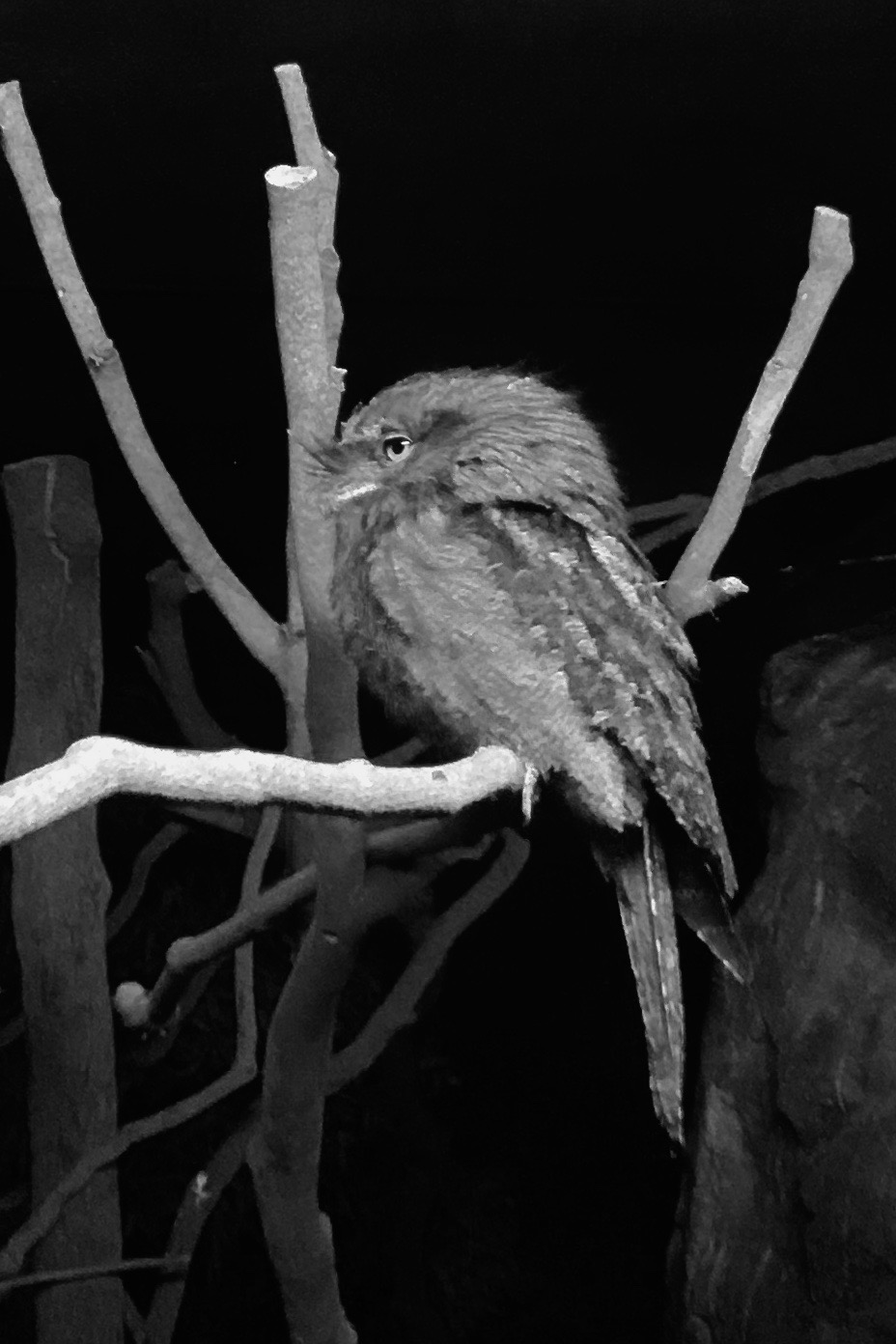
The Tawny Frogmouth is a dull beige and brown and blends in incredibly well in the bush, often looking like the broken stub of a tree branch.  This photo is black and white because the birds are nocturnal and their enclosure is very dark.


Gouldian Finches live in far northern tropical Australia


Common Wombat


Kingfisher


Thursday, 7 February 2019

Octopus Encounter

From previous trips we know that Australia is home to the most colorful, fascinating, and just plain cool animals, but nothing quite prepared us for an octopus encounter yesterday at Newcastle Beach.  

Dave and I were standing in shallow water exploring rock pools at low tide when I felt a strange sort of sucking sensation on my foot.  I looked down and there was an octopus arm reaching out from under a rock exploring my foot!


Though I pulled my foot back, the octopus’s touch was gentle and not at all scary, just a little surprising. As we continued to watch, the curious critter stretched an arm up along the rocks and out of the water.


 And then I felt another strange sucking sensation – it was a second octopus under the next rock!   

We watched both octopi for a long time and Dave bravely offered up his own foot for further octopus exploration.  Again, the touch was gentle, and though Dave could easily withdraw his foot, he said the suckers really held on tight.

A dead crab floated by on the water and we decided to see what would happen if we put it next to the octopi. 


Sure enough, one of them quickly grabbed ahold of the crab and pulled it back towards its mantle. It sucked it well into its body but then suddenly ejected it.  Apparently octopi prefer fresh crab.


Then the second octopus, which seemed a bit more curious and bold than the other one, came all the way out of his hidey-hole and started to swim away.


It’s hard to put into words how marvelous this experience was for Dave and me.  We observed the octopi for at least 45 minutes and the whole thing was absolutely fascinating.  We were thrilled and amazed to have this rare opportunity to interact with such unique and almost otherworldly wild animals. 


Tuesday, 5 February 2019

Australia Day 2019

Australia Day in Sydney is a sight to behold.  Color, pageantry, drama, and the lovely people of Australia celebrating together this lucky country.  We were privileged to be part of the festivities on 26 January, two days after we arrived in Australia.


The best place to be on Australia Day is in Sydney Harbour and so we were, together with our friends Peter and Janette and Paul and Cindy – out on a boat, enjoying a seafood buffet and watching all the action on the water.


All decked out in festive regalia


I don't eat oysters very often but when I do, 
I do it on a boat in the middle of Sydney Harbour


A little champagne helps the oyster go down

There is so much going on across the Harbour and it’s great fun to be right in the middle of it.


Many private boats are decked out to celebrate


The fireboat uses it's water canons to clear the center of the 
harbour so that the ferry boats can race


A Qantas A380 flies over the harbour 


Monday, 4 February 2019

Arthurs Pass – Part 2, The Bealey Valley Track

The Bealey Valley Track starts with a rough climb up through tree roots and boulders.


The track then crosses the Bealey Chasm, a narrow chute of huge white boulders with turquoise water cascading through them.


The steep path continues through a thick beech forest before suddenly opening up onto a boggy snow grass meadow surrounded by mountains.


Those are snow grass tussocks in the foreground
  
The alpine meadow has many unusual plants and is quite beautiful.


This bright red sundew, a carnivorous plant is tiny, about the size of a pencil eraser 


White Gentian 


On our way back down the track I was able to get a shot of a tiny bird, 13 cm (5 inches) tall.


 Ngirungiru - South Island Tomtit


A relatively flat part of the track


In the last blog, Arthurs Pass - Part 1, I wrote about the challenges of building the Otira Railway Tunnel.  We discovered that there also is a massive 440 meter (1440 feet) long vehicle overpass called the Otira Viaduct in the pass, spanning a deep and seismically unstable canyon.  It was opened in 1999 to replace a narrow winding road, called the Zig-Zag. 


In 1929 an earthquake caused a section of the Zig-Zag to slip into the canyon and in 1943 there was further erosion of the road, all of which convinced the government that the viaduct must be built.   Rock falls and water damage continue to be risks, even today, so protection was included when the viaduct was built.

Rock avalanche protection – You can see the rock fall protection structure 
on the left and a giant “downspout” carrying water over the road on the right

Monday, 28 January 2019

Arthurs Pass - Part 1

Our final adventure in New Zealand took us to Arthurs Pass, a magical, almost primordial place.  This pass over the Southern Alps connects the east and west side of the South Island. Though the Maori discovered and walked the pass for generations, building the road and railroad through the Alps was a very challenging job.  The final piece of the railway, the Otira Tunnel, opened in 1923. It is more than 8.5 km (5.3 miles) long with a steep grade of 1:33 and took 16 years to complete.

Though the drive and train ride through the pass are gorgeous, it is the hiking that is really mind-blowing.  Tall beech trees tower over steep, rocky paths sunk between moss covered boulders, ferns, and all kinds of rare and exotic shrubs.  There is water everywhere, running down the trail, dripping from the side of a pebbly bank, or falling for metres down a sheer rock face.

We did three hikes while in the pass, the Millennium Walk, Arthurs Pass Walking Track, and part of the Bealey Track. I hope my pictures give you a least a small sense of the primeval beauty of this place.  


Arthurs Pass Walking Track


Avalanche Creek Falls


Beech Trunk and Moss


Unnamed waterfall


Moss - so many amazing varieties


Beech trees over an unnamed waterfall


Mossy path through the beech trunks


Devil's Punchbowl Falls


Monday, 21 January 2019

Otago Peninsula – Part 2

The Otago Peninsula coast is incredibly windy and it’s not uncommon to have gusts up to 120 km/h (about 75 mph).  The few trees found there are tipped or even bent flat by this constant and powerful wind.


New Zealand Fur Seals are abundant both here and in Australia and are easy to see all along the coast.  Spring and summer is an especially fun time to watch them because the mothers have young pups with them.  Male furs seals have nothing to do with raising the young and females must do it all on their own.  Pups nurse for 300 days or more so this is serious work for the mum.  She will spend 1-20 days at a time at sea feeding while the pup waits on shore for her to return.  The length of time she is away increases as the pup grows and becomes more independent.


Nursing pup


The New Zealand Sea Lion is one of the most rare sea lion species in the world and found only here.  It is highly endangered with perhaps only 10,000 animals left.  There are signs of species recovery but it is happening at a very slow rate.  This is because there are many more males than females.  Since each female gives birth to only one pup every one to two years, birthrates overall are low.  Under better circumstances a single bull sea lion will have his own harem of 20 – 25 females.  On the Otago Peninsula females are very rare and some bulls actually create a harem of young male sea lions as a replacement.  


Two young males playing


Mature male and smaller immature "harem" male 


The darker the fur, the older the animal so this is an older but still 
juvenile male with a younger male in the foreground


Another extremely rare and wonderful species we saw on the peninsula is the Yellow-eyed Penguin.  The estimated population worldwide is only 4,000.  There is a breeding colony of about seven pairs near Papanui Beach and we actually saw seven or eight different birds when we were there. These penguins nest in the forest above the beach.  They are out at sea feeding all day and then return at dusk, hopping across the beach and then up a steep hill to their nesting grounds in the woods.  The eggs and chicks are vulnerable to introduced predators such as stoats, cats, and ferrets.  Just a few days before we visited Papanui Beach an egg disappeared and the nest was abandoned, a true loss to this small population of beautiful birds.


Crossing the beach


Getting ready to climb the hill to its nesting grounds


2020 Trip Canceled

Dear Readers, due to a family health situation, we have had to cancel our trip to Australia this year.  I'm happy to report that the sit...